WhatsApp: +86-185-5601-8866
Heating Equipment
News
2026-04-08
The element bundle configuration within a flanged heater directly determines how evenly heat is distributed across the fluid and how likely localized hot spots are to develop. In practical terms, hairpin configurations offer the most compact heat delivery, over-the-side bundles provide superior fluid circulation geometry, and U-bundle designs excel in high-pressure or high-temperature process applications. Choosing the wrong configuration for your medium and vessel geometry can reduce heater lifespan by 30–50% and increase the risk of fluid degradation or element burnout.
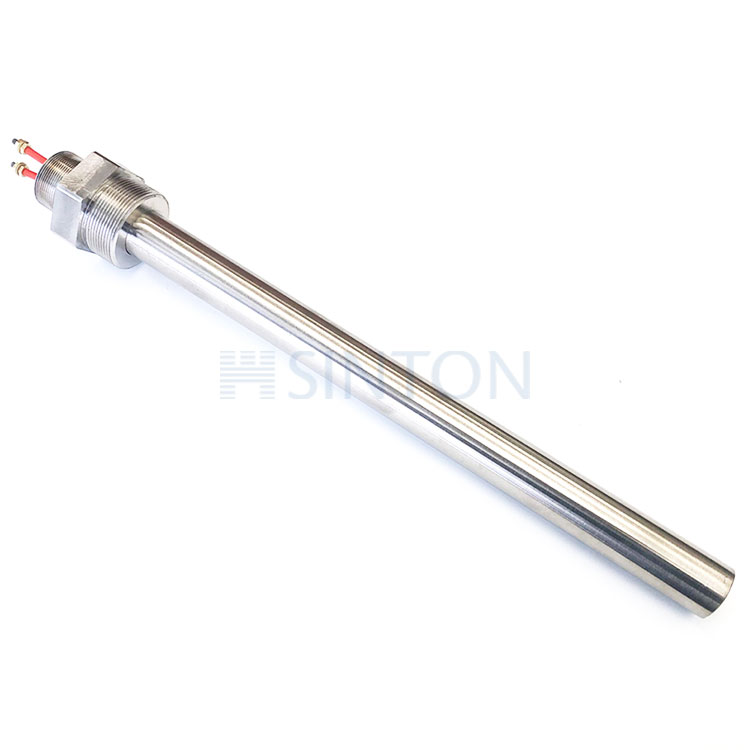
A flanged heater consists of one or more resistive heating elements mounted onto a flange plate, which bolts directly into a tank, vessel, or pipe nozzle. The arrangement of these elements — their geometry, spacing, and orientation relative to the fluid — is referred to as the element bundle configuration.
The bundle configuration affects three critical performance parameters:
In a hairpin configuration, the heating element is bent back on itself in a U-shape so that both terminal ends exit through the same flange face. This is the most commonly used design in flanged heaters due to its mechanical simplicity and compact installation footprint.
Hairpin elements are typically arrayed in parallel rows across the flange. When spacing between elements is insufficient — generally less than 1.5 times the element sheath diameter — thermal plumes from adjacent elements overlap, creating zones of elevated temperature. In low-viscosity fluids with good natural convection (such as water or light thermal oils), this is rarely problematic. However, in viscous media like bitumen or heavy fuel oil, poor inter-element spacing can allow surface temperatures to exceed safe limits by 50°C or more.
The bend radius at the hairpin tip is a known vulnerability. If the bend is too tight or the element is installed near the tank wall, fluid circulation at that point becomes restricted. Engineers typically recommend a minimum clearance of 25 mm between the hairpin tip and any vessel surface to maintain adequate fluid movement and prevent localized overheating.
Over-the-side flanged heaters position the element bundle so it hangs vertically or at an angle along the interior wall of a vessel, rather than projecting horizontally from the bottom or side. This geometry takes direct advantage of natural convection: as heated fluid rises from the elements, cooler fluid descends along the vessel walls and sweeps back over the bundle.
This vertical orientation promotes a continuous convective loop, significantly improving heat distribution uniformity throughout the fluid volume. In comparative thermal imaging tests of identically rated flanged heaters, over-the-side configurations have demonstrated temperature uniformity within ±5°C in open tanks, compared to ±15–20°C for horizontal hairpin arrays under similar watt densities and fluid conditions.
Hot spot risk is relatively low in this configuration, provided the fluid level is consistently maintained above the top of the element bundle. A drop in fluid level that exposes the upper elements to air or vapor can cause immediate dry-fire conditions, typically resulting in element failure within minutes. Most over-the-side flanged heater assemblies include a low-level cutout sensor set at a threshold of at least 50 mm above the top element.
The U-bundle design arranges multiple straight element legs in a parallel bundle, connected at the far end by a return header. This configuration is structurally robust and is favored for pressurized vessels, closed-loop circulation systems, and high-temperature process heaters operating above 200°C.
In forced-flow systems, a U-bundle flanged heater can be engineered so that fluid flows perpendicular to the element legs, maximizing turbulent contact and heat transfer efficiency. With proper baffle design and a minimum fluid velocity of 0.3 m/s across the bundle, surface-to-fluid temperature differentials can be kept below 30°C even at high watt densities of 6–8 W/cm².
The primary hot spot risk in U-bundle flanged heaters arises at the return header if stagnant pockets form there. Additionally, at the inlet end of the bundle where fluid is coldest, the temperature differential between element surface and fluid is greatest. This is where coking of hydrocarbon fluids most frequently initiates. Staggered element pitch — typically 2× the sheath diameter — is recommended to prevent this.
| Parameter | Hairpin | Over-the-Side | U-Bundle |
|---|---|---|---|
| Typical Watt Density Range | 1.5 – 7 W/cm² | 1.5 – 5 W/cm² | 3 – 10 W/cm² |
| Heat Uniformity | Moderate | High | High (forced flow) |
| Hot Spot Risk | Medium–High | Low–Medium | Low (with flow) |
| Best Application | Open tanks, low-viscosity fluids | Open tanks, natural convection | Pressure vessels, circulation loops |
| Pressure Suitability | Low–Medium | Low | High |
| Maintenance Access | Easy | Easy | Moderate |
No bundle configuration performs optimally in isolation — its effectiveness is inseparable from the thermal and physical properties of the fluid being heated. The two most critical fluid variables are viscosity and thermal conductivity.
For example, water (thermal conductivity ≈ 0.6 W/m·K) readily absorbs and redistributes heat, making it forgiving of suboptimal bundle geometries. Heavy fuel oil, with a thermal conductivity of only 0.12–0.15 W/m·K and a viscosity that can exceed 1,000 cSt at 20°C, creates a stagnant boundary layer around each element. In this scenario, a hairpin flanged heater with standard spacing will accumulate heat at the element surface much faster than the oil can absorb it, triggering hot spots at watt densities as low as 2.5 W/cm².
The practical guidance is straightforward: for fluids with viscosity above 500 cSt at operating temperature, watt density must be reduced and element spacing increased, regardless of bundle type. Over-the-side or U-bundle configurations with wide pitch and low watt density are strongly preferred in these cases.
When specifying a flanged heater for a new or replacement application, consider the following selection criteria:
The element bundle configuration of a flanged heater is not a secondary specification — it is a primary engineering decision that governs thermal performance, operational reliability, and service life. Hairpin designs offer simplicity and compact installation but demand careful attention to element spacing and tip clearance. Over-the-side configurations leverage natural convection to deliver excellent heat uniformity in open tank applications. U-bundle designs, when paired with forced fluid flow, provide the highest watt density capability and the lowest hot spot risk of the three configurations.
Matching the bundle geometry to the fluid properties, vessel geometry, and operating pressure is the single most effective step an engineer can take to extend flanged heater life, protect fluid quality, and reduce unplanned downtime. When in doubt, conservative watt density selection and wider element spacing will always outperform the alternative.
Looking For Business Opportunity?
Request for a call today
WhatsApp: +86-185-5601-8866
Tel: +86-185-5601-8866
E-mail: [email protected]
Address: Sinton Building, No. 886 Yandu Road, Yandu District, Yancheng City, Jiangsu Province
Friendly Link: www.cn-lvdao.com www.sealing-china.com
Products
Message