WhatsApp: +86-185-5601-8866
Heating Equipment
News
2026-01-12
High-Purity Magnesium Oxide (MgO) Insulation
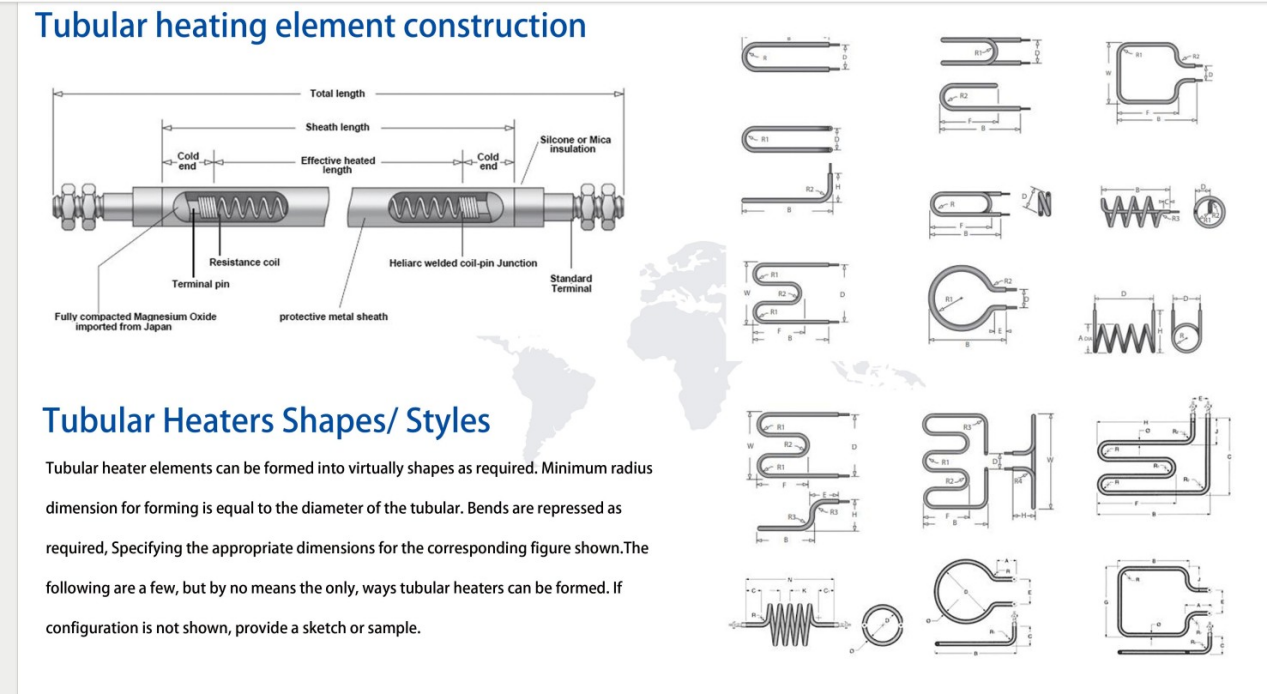
The primary electrical insulation within tubular heater is composed of high-purity magnesium oxide (MgO), which serves a dual purpose of providing excellent dielectric resistance while facilitating efficient thermal transfer from the internal resistance wire to the sheath. The purity of MgO is critical because any impurities or moisture content can significantly reduce insulation resistance and increase the risk of leakage current. MgO is compacted to eliminate voids and ensure consistent coverage around the resistance wire, allowing it to withstand elevated voltages without breakdown. Its crystalline structure remains stable under extreme temperatures, which is particularly important in continuous-duty industrial applications, where thermal cycling or prolonged high temperatures could otherwise degrade lower-quality insulating materials. MgO has a high thermal conductivity, which ensures that heat is rapidly and evenly transmitted to the sheath, avoiding hotspots that could compromise the electrical integrity of the insulation system. Its chemical inertness and resistance to oxidation also make it suitable for use in aggressive or humid industrial environments, maintaining electrical isolation and long-term reliability over the heater’s operational lifespan.
Centralized Resistance Wire Geometry
In tubular heater design, precise positioning of the resistance wire along the central axis of the metallic sheath is critical to achieving uniform insulation thickness, which is essential to prevent localized dielectric breakdown. When the resistance wire is perfectly centered, the magnesium oxide insulation envelops the wire evenly, eliminating thin spots that could result in leakage currents or premature failure. This concentric geometry also optimizes heat distribution, minimizing thermal stress on the insulation that could lead to micro-cracking over time. The central alignment contributes to the structural stability of the heater during thermal expansion and mechanical vibration, preventing displacement of the wire or insulation settling that could create conductive paths. Engineers carefully calculate the spacing and wire diameter relative to the sheath to balance watt density, thermal output, and insulation resistance, ensuring both safety and efficiency. In addition, this design approach allows the tubular heater to maintain high insulation resistance over extended operational periods, even under conditions of frequent on/off cycling or variable voltage loads, which is critical for industrial processes that demand consistent and predictable thermal performance.
Mechanical Compaction and Swaging Process
The magnesium oxide powder inside a tubular heater is compacted through a carefully controlled mechanical process, which may involve swaging, drawing, or cold pressing, to produce a dense, uniform insulating layer. This compaction eliminates air pockets and micro-voids that could act as pathways for electrical leakage or facilitate moisture penetration, both of which would degrade insulation resistance over time. A densely compacted MgO layer also significantly enhances the thermal conductivity of the insulation, ensuring rapid heat transfer from the resistance wire to the outer sheath while maintaining electrical isolation. Swaging and drawing also mechanically stabilize the internal components, reducing the risk of wire movement during thermal expansion cycles or vibration in industrial equipment. Engineers optimize the compaction parameters, such as pressure and powder particle size, to achieve a balance between maximum dielectric strength, structural integrity, and efficient thermal performance. The result is a tubular heater capable of maintaining exceptionally low leakage currents and high insulation resistance throughout its operational lifetime, even in environments characterized by high temperatures, mechanical shock, or prolonged continuous operation.
Hermetic Sealing of Terminations
The ends of a tubular heater are critical points where electrical insulation can fail if not properly sealed. Hermetic sealing of terminations using ceramic beads, glass-to-metal seals, high-temperature epoxies, or mechanically crimped closures prevents ingress of moisture, dust, oils, or corrosive chemicals, which could significantly reduce insulation resistance and lead to leakage currents. This sealing is particularly important in industrial, food processing, chemical, or outdoor applications where exposure to liquids or airborne contaminants is common. Effective end sealing also ensures mechanical stability of the internal conductor and MgO insulation during thermal cycling, preventing movement or settling that could create conductive paths. Engineers carefully select sealing materials based on thermal expansion compatibility, chemical resistance, and dielectric properties to maintain a stable, long-term electrical barrier between the heating element and the grounded sheath. Properly sealed terminations, combined with high-density MgO insulation and precise wire alignment, ensure that the tubular heater maintains both safety and operational efficiency under harsh or variable environmental conditions.
High-Integrity Sheath Materials
The outer sheath of a tubular heater serves multiple critical functions beyond mechanical protection: it provides grounding, chemical resistance, and thermal conduction. Common sheath materials such as stainless steel, Incoloy, Inconel, or copper are selected based on their ability to resist corrosion, oxidation, and mechanical wear while maintaining structural integrity at high operating temperatures. The sheath acts as the primary grounded barrier between the resistance wire and the external environment, ensuring that any electrical fault current is safely diverted to ground. Material selection also considers compatibility with the magnesium oxide insulation and the resistance wire, minimizing the risk of galvanic corrosion or contamination that could degrade insulation resistance. The sheath’s mechanical strength prevents deformation or cracking that could expose the internal conductor and create leakage paths. The sheath’s thermal conductivity ensures rapid heat transfer to the surrounding medium, allowing the heater to operate efficiently without compromising the dielectric performance of the MgO insulation, even during prolonged high-temperature operation.
Looking For Business Opportunity?
Request for a call today
WhatsApp: +86-185-5601-8866
Tel: +86-185-5601-8866
E-mail: [email protected]
Address: Sinton Building, No. 886 Yandu Road, Yandu District, Yancheng City, Jiangsu Province
Friendly Link: www.cn-lvdao.com www.sealing-china.com
Products
Message